
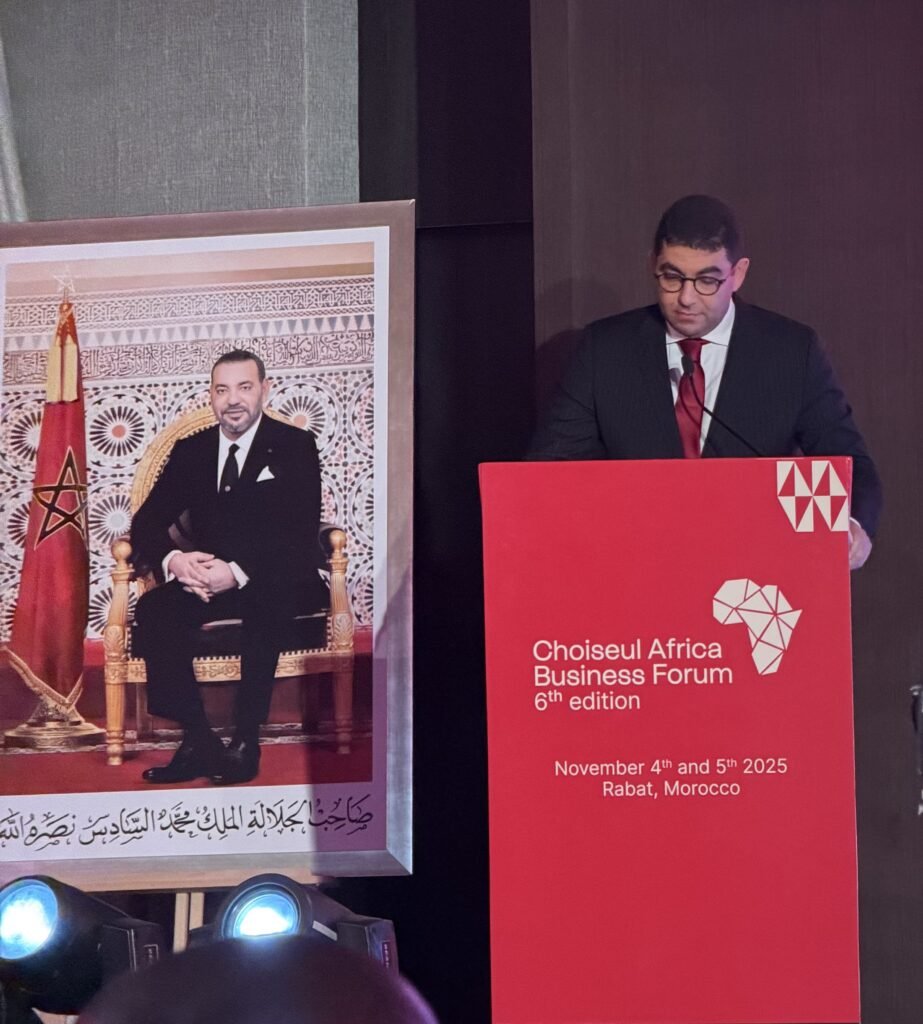
On November 4 and 5, 2025, the city of Rabat hosted the 6th edition of the Choiseul Africa Business Forum, a leading economic event bringing together public decision-makers, industrial leaders, and African and European institutional players.
Under the theme "Made With Africa, " this edition highlighted the continent's industrial transformations, energy transition challenges, and new sustainable economic models based on innovation and international cooperation.
Among the participants was Jean-Baptiste Sandoz, founder of Company Project and French Ambassador for the European Climate Pact, who contributed to discussions on sustainable industrialization and the structuring of high-impact local industries.
Strategic exchanges at the heart of African industrial issues
Throughout the forum, round tables and bilateral meetings provided an opportunity to address issues that will shape the economic future of the African continent:
- energy transition,
- sustainable infrastructure,
- material circularity,
- industrial logistics,
- emerging technologies and artificial intelligence,
- skills development and structuring of local industries.
In this context, Jean-Baptiste Sandoz spoke with several leading executives and institutional officials, including:
- Youssef Ahizoune, CEOof ARMA ( Morocco), a major player in waste management,
- Jens Gabriel, director of NordAlu, specialist in industrial aluminum,
- Diaretou Madina Gaye Dieng, President of Schneider Electric's Francophone Africa & Islands Cluster,
- Amer Benouda, Vice Presidentof ABA Technology, a leading Moroccan group in Industry 4.0,
- Papa Amadou Sarr, CEO of the Porteo Group, former senior executive at the African Development Bank,
- Dr. Paul Koffi Koffi, Commissioner of the West African Economic and Monetary Union (UEMOA) and former minister,
- Mohamed Mehdi Bensaïd, Moroccan Minister of Youth, Culture, and Communication,
- Mouad Hajji, General Coordinator of the 2030 World Cup (FRMF) and former Secretary General of CAF.
These discussions highlighted a strong consensus on the need to build a more sustainable, resilient industrialization model that creates local value.
Circular economy and sustainable industrialization: a shared vision
As the discussions progressed, one conclusion became clear:
Africa's industrial transition cannot be sustainable without strong integration ofthe circular economy.
Waste recovery, reducing dependence on virgin raw materials, and structuring local value chains appear to be essential levers for combining economic competitiveness, industrial sovereignty, and ecological transition.
This approach is in line with the vision of Company Project, which develops industrial solutions that transform waste into resources through advanced, replicable processes adapted to local conditions.
Africa–Europe cooperation in support of transitions
AsAmbassador for the European Climate Pact, Jean-Baptiste Sandoz emphasized the importance of building balanced partnerships between Africa and Europe, based on the transfer of know-how, industrial innovation, and the creation of shared value.
The challenge is no longer just to export technologies, but to build local industrial ecosystems capable of meeting regional needs while contributing to global climate goals.
A forum revealing current dynamics
The sixth edition of the Choiseul Africa Business Forum confirms the growing role of Africa-Europe alliances in shaping the industrial sectors of tomorrow.
Jean-Baptiste Sandoz's participation is part of this dynamic, at the crossroads of industrial innovation, the circular economy, and international cooperation, illustrating the rise of more sustainable and resilient economic models.
Conclusion
In Rabat, the Choiseul Africa Business Forum 2025 demonstrated that the industrial future of the African continent will be built with Africa, fully integrating the challenges of sustainability, circularity, and sovereignty.
A powerful message shared by stakeholders who are convinced that sustainable industrialization is now a strategic pillar of economic development and international cooperation.


0 comments