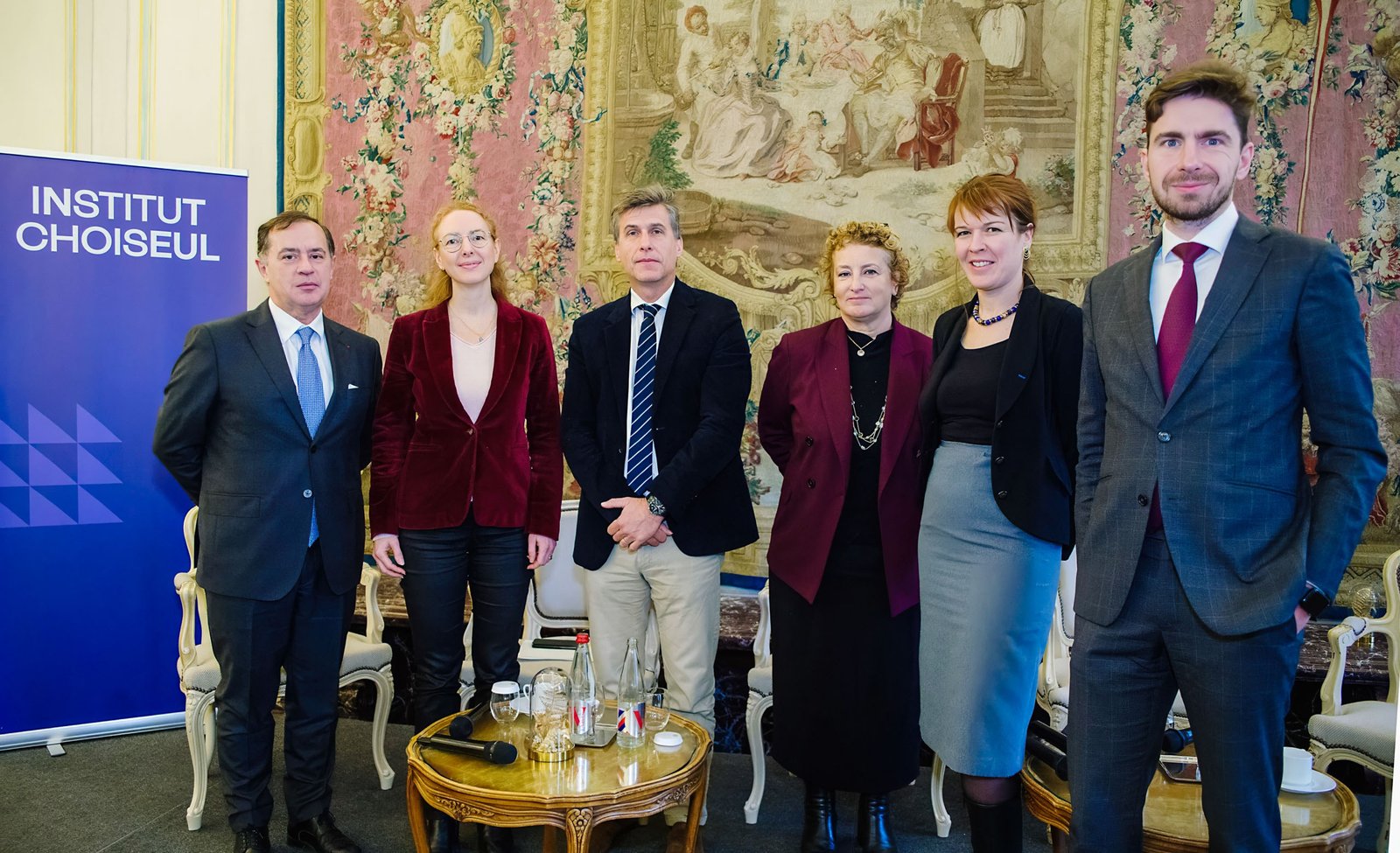
Invited to Choiseul Souveraineté, Jean-Baptiste Sandoz attended discussions on nuclear and geothermal energy. He did not participate in the round table, but followed the debates and discussions between public decision-makers and industrialists with great interest.
Although his presence initially surprised some participants, it quickly highlighted an essential question that is too often absent from debates: can we really talk about energy sovereignty without questioning our consumption of materials and energy?
A roundtable focused on production... but incomplete
The round table brought together key figures in French energy and industrial policy:
Pierre Brossollet (Arverne Group), Sophie Mourlon (Ministry of Energy Transition), Catherine Lagneau (BRGM), and Valérie Faudon (Sfen).
The discussions highlighted two key pillars:
- nuclear power, guarantor of national stability and energy independence,
- Geothermal energy, a regional solution for securing local heating networks.
A solid diagnosis. But incomplete.
The question that turned the discussion around
It was during an informal exchange on the sidelines of the round table that Jean-Baptiste Sandoz was asked a question:
"Why is an expert in circular economy interested in energy sovereignty?"
The answer leaves a lasting impression.
"There is a lot of talk about the production mix. Sovereignty also depends on reducing demand. Every ton of recycled material means primary energy that is not consumed."
A moment of silence. Then, a revelation.
The circular economy, a forgotten lever for energy sovereignty
Reducing energy dependence is not just about producing differently.
It also means producing less, better, and for longer.
- Recycling, repairing, reusing: these are all ways to reduce pressure on energy infrastructure.
- A circular industry consumes less energy than an extractive industry.
- A material that is already in circulation is a material that no longer needs to be extracted, processed, or transported.
Energy sovereignty cannot therefore be separated from material sovereignty.
Towards a three-pronged strategy: energy, territories, and circularity
The vision that is emerging is clear and structuring:
- Nuclear power as a foundation for national stability.
- Geothermal energy as a tool for regional resilience.
- The circular economy as a lever for industrial and energy efficiency.
Considering these three dimensions separately weakens the entire system.
Considering them together, on the other hand, makes it possible to build a coherent, sustainable, and economically viable strategy.
Company Project: acting on demand, not just supply
This is precisely where Company Project comes in.
By transforming waste into resources, structuring local supply chains, and promoting circular reindustrialization, the company is helping to reduce overall energy and raw material consumption.
A pragmatic approach, rooted in local communities, consistent with the European objectives of the Climate Pact, for which Jean-Baptiste Sandoz is Ambassador.
Thinking differently about the future
Energy sovereignty will not be achieved solely in power plants or underground.
It will also be built in factories, territories, value chains, and industrial choices.
Thinking about energy without thinking about matter is a strategic error.
The future lies at the interface between the two.


0 comments